- Layers in API-led Architecture
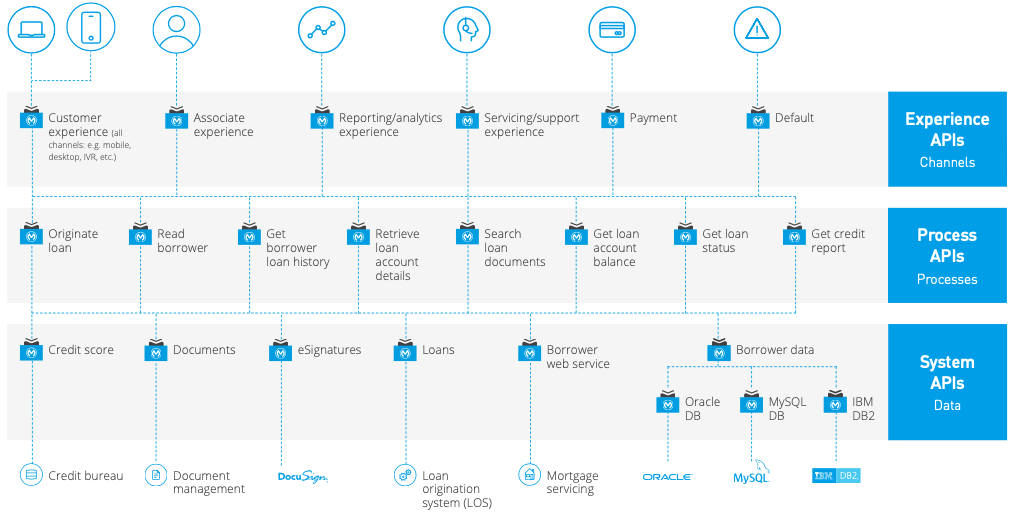
In the MuleSoft integration space, preparing an API-led integration architecture is divided into 3 layers.
- The top most layer is called the Experience Layer which enables users to interact with an IT ecosystem of a business.
- The middle layer is called the Process Layer, which pulls data from bottom layer(System Layer), applies business logic to process the data and pushes the data in any desired format asked by the top layer(Experience Layer).
- The bottom most layer is called the System Layer, which houses the core systems in an IT ecosystem. Which we can treat root API of the API-led ecosystem
Experience APIs
Experience APIs are simple. This API is exposed to out side world to use in mobile apps or Web Apps.
Experience APIs are the means by which data can be reconfigured easily to meet the needs of multiple audiences. Also, we can remove the unnecessary methods and expose only the necessary methods in Experience APIs in a simple way. So, to meet a wide range of clients that accept data in diverse formats, the Experience APIs do this rapidly, decreasing the time to market.
The Experience APIs are the final products of an organization in the API-led connectivity approach. Where organisation should enable multiple layers of security policy to make a product more secured.
Process APIs
Common business logic can be shared across the organization. For example, if an organization already has the purchase order process API implemented, it can be reused whenever necessary.
Process APIs feed in the request coming from Experience Layer and pass that to System Layer, without any need of interfering with the legacy systems.
The Process APIs should be held privately inside the organization as per recommendation and should not be exposed for public use.
In some use cases, the process layer is also not necessary. If a user request doesn’t need any complex information or no need of any transformations of data. Then there will be less role for process layers. In those cases we can avoid create an unnecessary process API.
System APIs
We can say System Apis are hearts of any API-led approach. As these API directly interest with backend systems and in response they provide the sensitive data of an organisation. And these APIs will be called by many intermediate APIs.
These type of APIs are the ones enabling loose-coupling by providing a platform to access systems of record, and exposing data into each record in a canonical format. This avoids any need of interfering with an already complex IT ecosystem present in the business.
Once it build, many intermediate APIs will use to get the system data. So, these API should have better performance with applied security policies.
Comments