- What is ESB?
- What is Mule ESB?
- What is Integration?
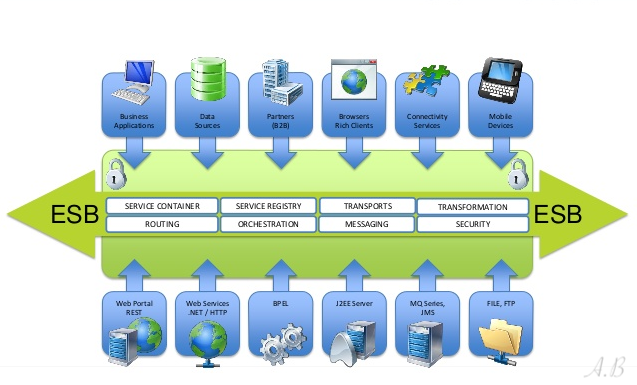
An Enterprise Service Bus (ESB) is fundamentally an architecture. It is a set of rules and principles for integrating numerous applications together over a bus-like infrastructure.
ESB products enable users to build this type of architecture, but vary in the way that they do it and the capabilities that they offer.
The core concept of the ESB architecture is that you integrate different applications by putting a communication bus between them and then enable each application to talk to the bus.
An enterprise service bus (ESB) implements a communication system between mutually interacting software applications in a service-oriented architecture (SOA).
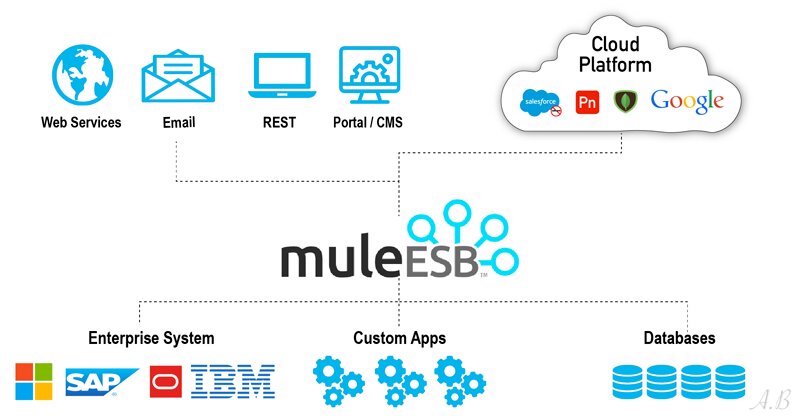
Mule, the runtime engine of Anypoint Platform, is a lightweight Java-based enterprise service bus (ESB) and integration platform that allows developers to connect applications together quickly and easily, enabling them to exchange data.
It enables easy integration of existing systems, regardless of the different technologies that the applications use, including JMS, Web Services, JDBC, HTTP, and more.
The ESB can be deployed anywhere, can integrate and orchestrate events in real time or in batch, and has universal connectivity.
At the simplest level, integration is the process of combining two or more things to create a whole. For businesses, the term integration often refers to software or system integration, which means bringing together multiple business systems to operate as a collaborative unit.
In current day. MuleSoft’s Anypoint Platform is the world’s leading integration platform for SOA, SaaS, and APIs. MuleSoft provides exceptional business agility to companies by connecting applications, data, and devices, both on-premises and in the cloud with an API-led approach.
I beleive you have understood details of Mule ESB, if so please follow with me to next topic on Introduction to Enterprise Integration Patterns.
Comments